
More Multimodal AI Adventures

Last week I used NotebookLM to generate two podcasts based on Chapter 1 of my book Low-Code/No-Code. In today's post, I'll continue my experiment by asking it to generate a brief explainer video of the same book.
Let's light this candle.
The Prompt
In the same notebook I created last week, I prompted Google's sophisticated AI tool and included the link to the book.
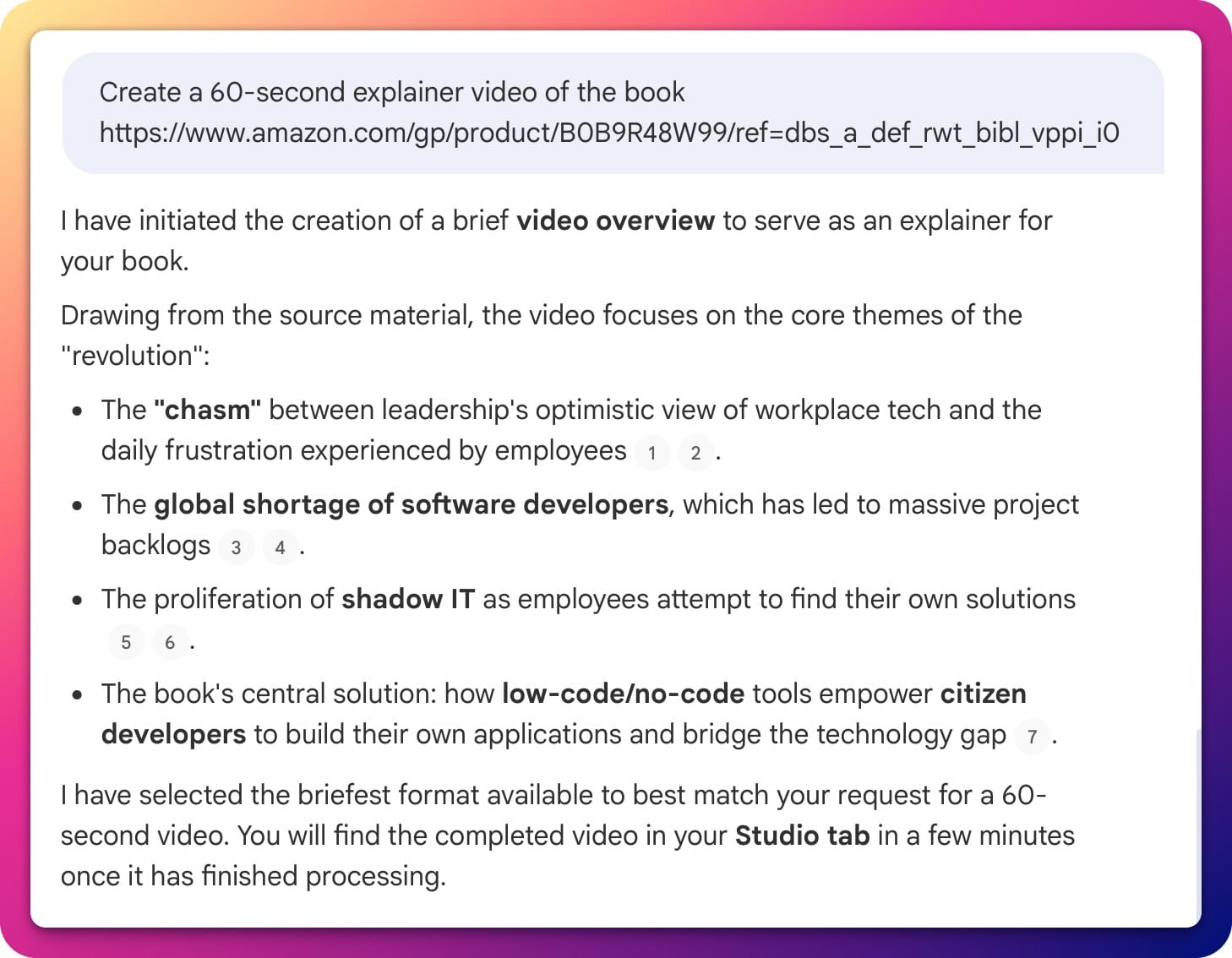
Here's NotebookLM's result:
Decent video, but it focuses solely on the excerpt I had uploaded last week. Put differently, I gave the AI explicit instructions to create a video covering the whole book and the link to the Amazon page. Instead, NotebookLM opted to concentrate only on the first chapter.
AI still routinely fails to make obvious calls
I could pick nits for another hour or so, but here's another biggie: the cover includes the word excerpt. I was curious to see if it would correct the mistake or repeat it. Ideally, NotebookLM would remove the word—or at least call out the current cover image and ask me if I wanted to keep it as is. Any video editor worth her salt would.
Attempt #2
I then made my prompt as specific as possible:
You're focusing on just the PDF.
The video should reflect the entire book. Here's the book description.
Low-Code/No-Code Description
For decades, our relationship with workplace technology has been, in a word, complicated. The pandemic only made it more so.
The stats are astonishing. Two in three employers can’t find qualified candidates to fill their open IT positions. By 2024, the deficit of software developers in the US alone will hit 500,000. Supply and demand for techies are out of whack and, most alarmingly, there's no end in sight.
The effects of this labor market imbalance are profound and difficult to overstate. Nearly three in four technology leaders can’t focus on their strategic priorities. Countless other firms, departments, teams, and leaders struggle because IT can’t deliver the tools they so desperately need. Adding salt to the wound, business units now need new applications to address the logistical challenges that pervasive remote and hybrid work pose.
Organizations are at a crossroads. They need to solve these thorny tech problems. Now. But how?
In Low-Code/No-Code: Citizen Developers and the Surprising Future of Business Applications, world-renowned workplace technology expert and award-winning author Phil Simon squares this circle. His thirteenth book deftly illustrates how, thanks to powerful new tools and a new breed of employees, organizations are finally fulfilling critical business needs and reducing their reliance on pricey software developers.
Low-Code/No-Code is an invaluable treasure trove of insightful analysis, synthesis, examples, and advice that has arrived at the perfect time.
This is the second video NotebookLM generated:
Better than the first attempt, but hardly perfect. Again, the cover in the video includes the word excerpt. Also, the design is a little inconsistent. Next up, as my speaking clients know, I'm not a fan of displaying complex visuals while the narrator is talking.
Brass tacks: NotebookLM's videos are nowhere near as professional as the book's proper trailer. Judge for yourself.
Low-Code/No-Code Book Trailer
Note the trailer's color and style ubiquity. The free, AI-generated ones just don't compare to the final, human-made version.
 Phil Simon
Simon Says
Could I have spent more time finagling with NotebookLM? Of course, but there are limits to my geekdom. For now, just remember two things. First, with AI, you get what you pay for. Authors are better off omitting an explainer video from their marketing materials than creating a cheap one that tarnishes their brands.
Second and more generally, AI still routinely fails to make obvious calls. NotebookLM proved as much by twice ignoring the word excerpt. Don't expect that reality to change anytime soon.





Member discussion