
 PHIL SIMON
Book #1
Why New Systems Fail
An Insider’s Guide to Successful IT Projects
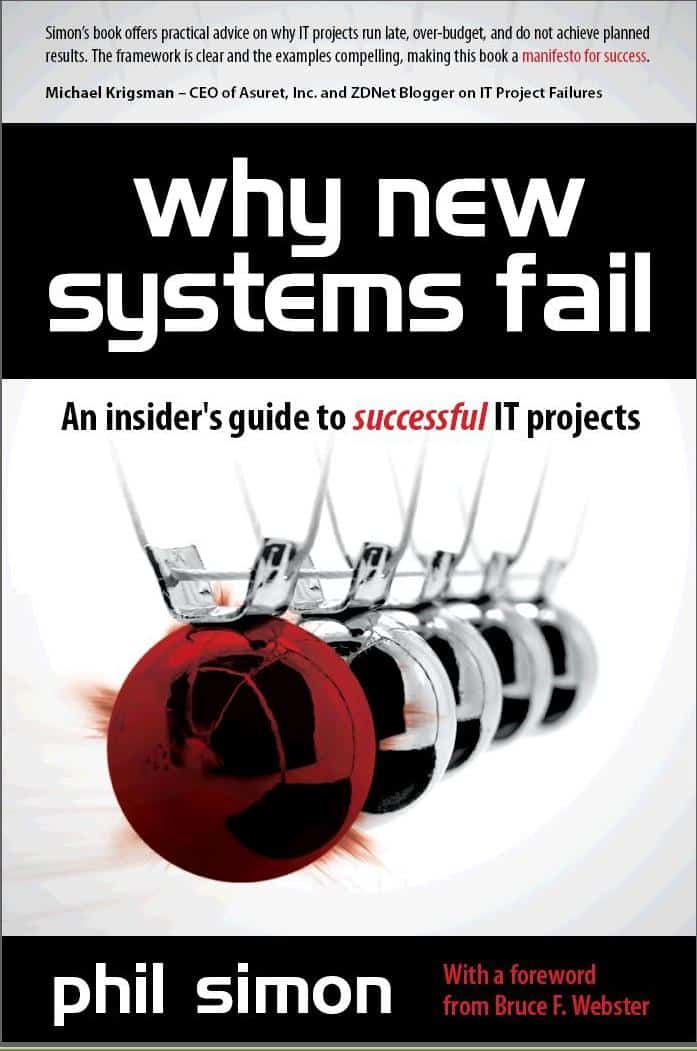
Simon’s framework is clear and his examples are compelling. This book is a manifesto for success.
—Michael Krigsman, ZDNet Blogger on IT Project Failures
About the Book ℹ️
Publication date: February 23, 2010. (Note that I originally self-published the first version of this book in February of 2009. I subsequently sold the rights to a proper publisher and penned the revised edition.)
Publisher: Cengage
A Fortune 500 manufacturing company spends millions attempting to implement a new enterprise resource planning system. Across the globe, a marketing firm with only 150 employees builds a proprietary customer relationship management application and fails miserably in deploying it.
These two very different companies did two very different things, but their outcomes were virtually identical. Both organizations failed to activate and use their systems as initially conceived by senior management. In the process, each organization struggled to recover.
And these two organizations are hardly alone. On the contrary, many studies have confirmed that more than three in five new system implementations fail. Many miss their deadlines. Others exceed their initial budgets, often by ghastly amounts. Even systems deployed on time and under budget often fail to produce their expected results. Many experience major problems almost immediately.
While the statistics are grim, there is at least some good news:
Organizations can avoid these failures.
Organizations often lack the necessary framework to minimize the chance of system failure before, during, and after system implementations. Why New Systems Fail provides such a framework with specific tools, tips, and insight from the perspective of a seasoned, independent consultant with more than a decade of related experience.
That’s me.
The book examines in great detail the root causes of IT project failures. It includes a panoply of case studies, examples, and lessons from actual system implementations.
Afraid of IT Jargon?
Don’t be. The book’s style is informative, straightforward, and very readable. More than a theoretical or technical text, Why New Systems Fail offers pragmatic advice for organizations both deploying new systems and maintaining existing ones.
Interesting Tidbits About the Book
After nearly a decade of working on large-scale IT projects, I had reached a professional crossroads. I had kept repeating the same exercise: organizational politics, thorny data issues, technophobes, toxic cultures, and questionable practices by software vendors and consultancies. The end result: expensive and frustrating system failures.
If I didn’t write this book, I would have needed to see a shrink.
Seriously.
I wrote about what I knew. It’s pretty common for a non-fiction writer to do this. I had seen so many IT projects blow up, why not write a jargon-free book about them? So I did.
Published in February of 2009, the book didn’t do particularly well until mid-July of that year. A Slashdot review catapulted it to number 91 on Amazon. I nearly broke my finger hitting the F5 key on my browser, watching that number break the top 100 books. (Back then, I wasn’t a Mac guy.) As Bill Murray said in Groundhog Day, “That was a pretty good day.”
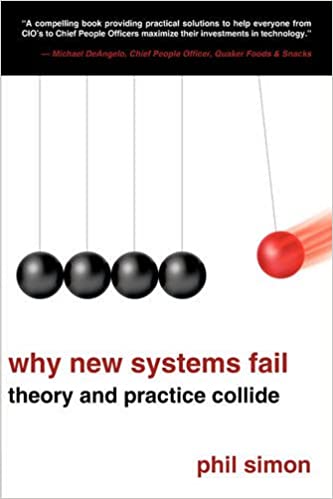
The original subtitle was “Theory and Practice Collide.” In hindsight, this was great imagery, but not too SEO-friendly. Here is the original cover.
Trailer
What’s the book about in 82 seconds? Watch below to find out.
Excerpt
Praise
“Projects are multi-dimensional. They’re technical, political, financial, personal, emotional, logistical and more. Great project leaders anticipate these dimensions before the project begins. Read Phil’s book to recognize the pitfalls and minimize the impact of them on your organization and your career. You can’t work the plan until you’ve really planned the work.”
–Brian Sommer, founder of TechVentive and Vital Analysis.

“A good read and as insightful as any I have read about enterprise software project management and the obstacles to success.”
–David F. Carr, independent journalist and former writer for Baseline Magazine
“This book offers practical advice on why IT projects run late, over-budget, or do not achieve planned results. The framework is clear and the examples compelling, making this book a manifesto for success.”
–Michael Krigsman, ZDNet Blogger on IT Project Failures
“Simon’s book should be required reading for all CIOs, IT project managers, and involved business managers prior to starting any such enterprise project. It’s clear that Simon knows exactly what he’s talking about and knows where all the bodies are buried.”
–Bruce Webster, Principal and Founder at at Bruce F. Webster & Associates